Rheology and outgassing of bubbly magmas
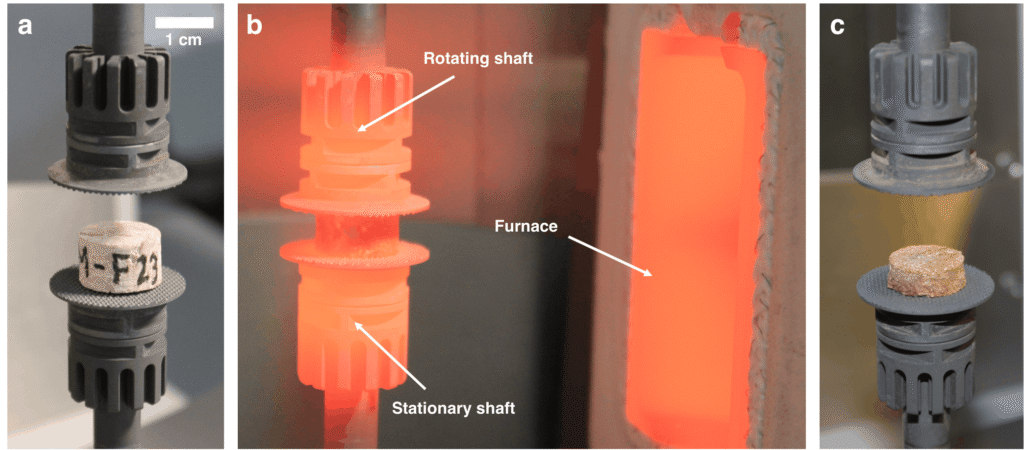
The dynamics and ensuing explosivity of volcanoes are largely controlled by the viscosity of their magma and by the ability of exsolved gases to vent to the surface. Magma is a complex mixture of a solid phase (crystals) and a gas phase (bubbles) dispersed in a liquid phase (the silicate melt). Understanding how bubbles affect the viscosity of the melt and how gas is lost from the magma is crucial for our ability to correctly model and interpret volcanic eruptions. To address these questions I have performed high-temperature deformation experiments on magma and magma analogues and developed widely applicable constitutive relations for the viscosity and outgassing behavior of bubble magmas.
Relevant papers: Ferrante et al., 2025; Ryan, Ferrante et al., 2026 (in revision).
Magma transport at open-system volcanoes
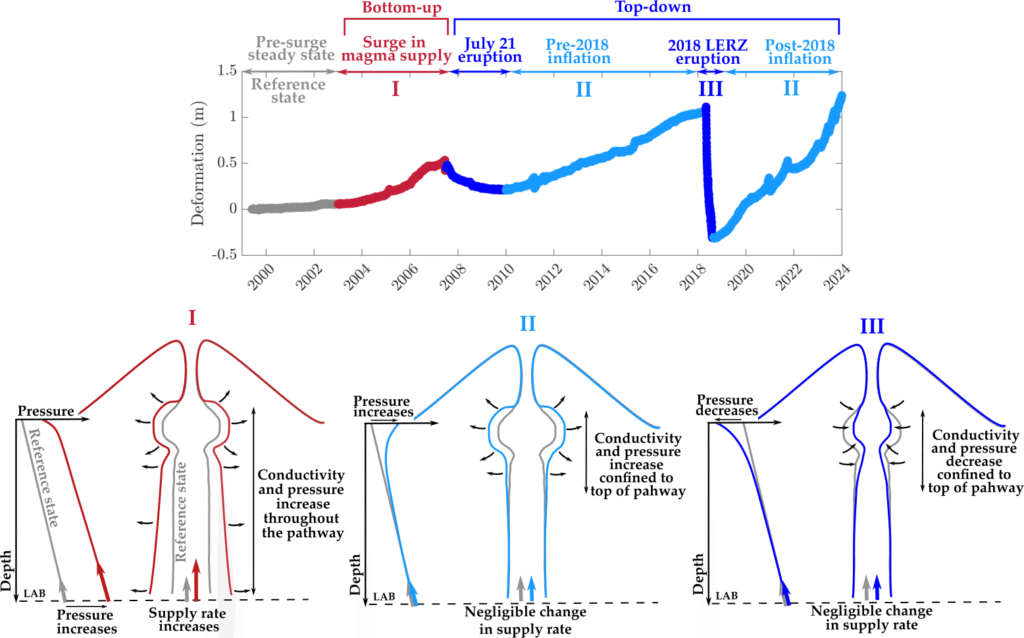
Open-system volcanoes are loci or near-continuous magmatic activity, which poses numerous hazards for nearby communities. Despite diverse and extensive monitoring, the lack of a plausible model of magma supply to volcanoes has hindered significant achievements in our understanding of the lithosphere-scale dynamics of open-system volcanoes. To fill this gap, I developed a numerical model of magma transport beneath open-system volcanoes, which I employed to explain 30 years of surface-available observations at Kīlauea volcano (Hawai‘i). I found that the pathway that supplies magma to Kīlauea likely responds in an elastic fashion to variations in pressure, changing in size as pressure changes. This leads to a fundamental difference in behavior between bottom-up and top-down processes. During bottom-up processes, changes in pressure and in pathway size reinforce each other, leading to sensible variations in magma supply rate that propagate to the volcano’s shallow magmatic system. Conversely, during top-down processes changes in pressure and in pathway size compensate each other, effectively decoupling the roots of the volcano from its shallow storage. This implies that magma supply to open-system volcanoes is mostly controlled by processes occurring at depth, and largely independent from shallow events such as eruptions and blockages, which have negligible impact on magma supply.
Relevant papers: Ferrante and Gonnermann, 2026; Gonnermann, Ferrante et al., 2026 (in prep.).
Dynamics of caldera-forming eruptions
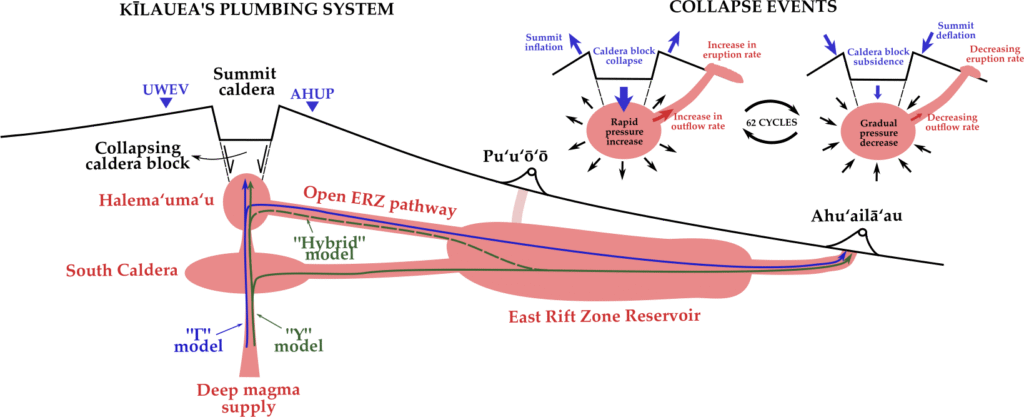
“Why eruptions end?” is a fundamental yet unexplored question in volcanology. Because of its unprecedented observational constraints, the 2018 eruption of Kīlauea volcano (Hawai‘i) represents an exceptional case study to address this question. The eruption resulted in the formation of a new summit caldera over 62 individual collapse episodes, and the effusion of lava in a residential area nearly 40 km away from the summit. In early August of 2018, after four months of continuous lava effusion, the eruption suddenly ended, taking volcanologists by surprise. Nearly eight years after the end of the eruption, the reasons underlying its sudden and unexpected conclusion remain, for the most part, a mystery. To address this question, I performed a systematic analysis of monitoring data collected during Kīlauea’s 2018 eruption. I proposed that the progression and ensuing conclusion of the eruption were the result of the interplay between gradually decreasing eruption rates and the strengthening of the caldera ring faults, which halted the collapses and consequently stopped the eruption. These results are fundamental to understand the evolution and end of past and future caldera-forming eruptions.
Relevant papers: Ferrante et al., 2026 (in review); Gonnermann, Ferrante et al., 2026 (in prep.); Ongoing project.
Spatio-temporal evolution of magmatism in rifts
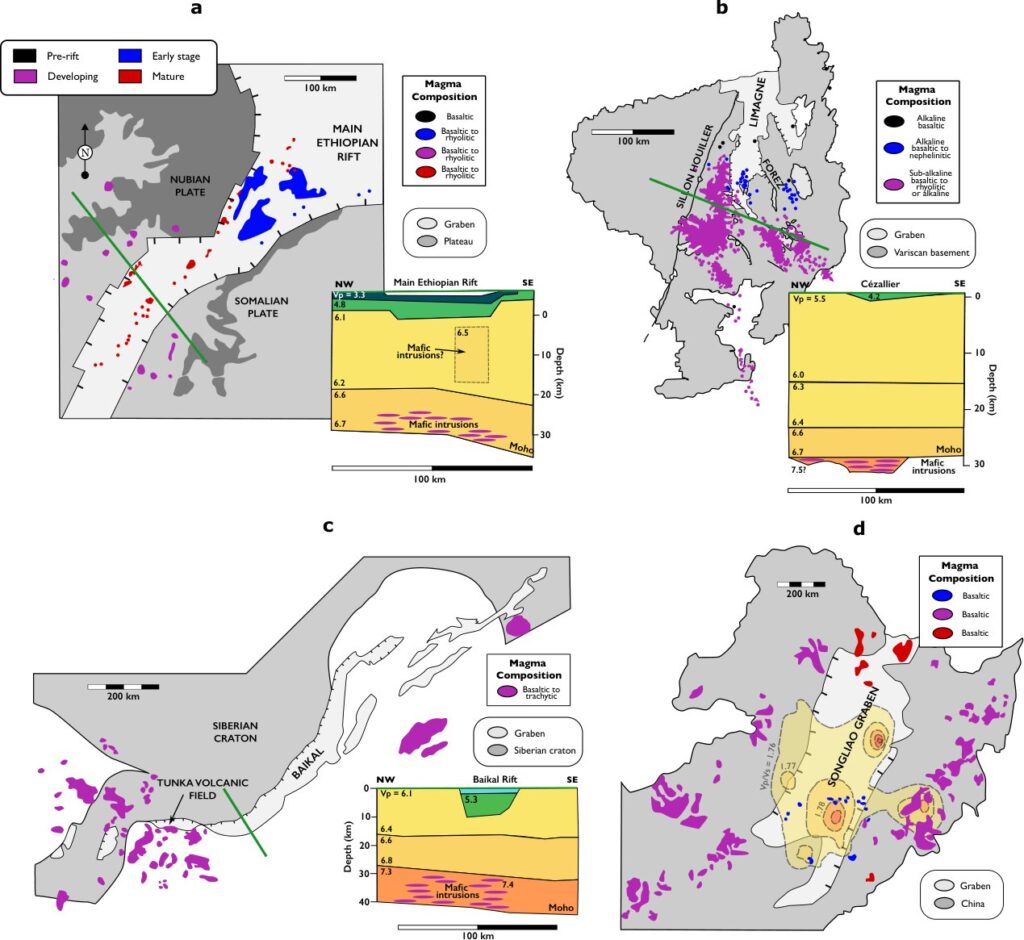
Continental rifts are regions of intense magmatic and volcanic activity. The spatial location of volcanoes in rifts are observed to shift over time during a rift’s lifetime – from the basin floor to its shoulders and back – and the reasons behind this transition have been long debated. In addition, large amounts of magma are observed to intrude the lower crust, forming near horizontal sill structures. Why some intrusions manage to make it to the surface while others become arrested at depth is still a major question in volcanology. Answering these outstanding questions requires a solid conceptual understanding of the mechanisms that affect magma trajectories in the crust and a corresponding physically-sound model of magma propagation. To solve these problems, I worked on a state-of-the-art numerical model of dike propagation in the the crust. I proposed that the spatio-temporal migration of magmatism in continental rifts can be explained by the evolution of the stresses generated in the crust by the deepening rift basin. As the Earth’s lithosphere is stretched and thinned during continental rifting, magma is generated at depth, eventually reaching the surface through magma-filled fractures, i.e. dikes. Since dikes open in the direction of least compression, their trajectories are highly sensitive to changes in the surrounding stress field. The progressive deepening of the rift basin with time deflects dikes towards the flank shoulders and eventually creates a stress barrier that favors the arrest of dikes at depth. These results have major implications for hazard assessment near volcanically active rifts, as well as on the formation of mineral and geothermal resources.
Relevant papers: Ferrante et al., 2024; Franceschini,…, Ferrante et al., 2026 (in review).